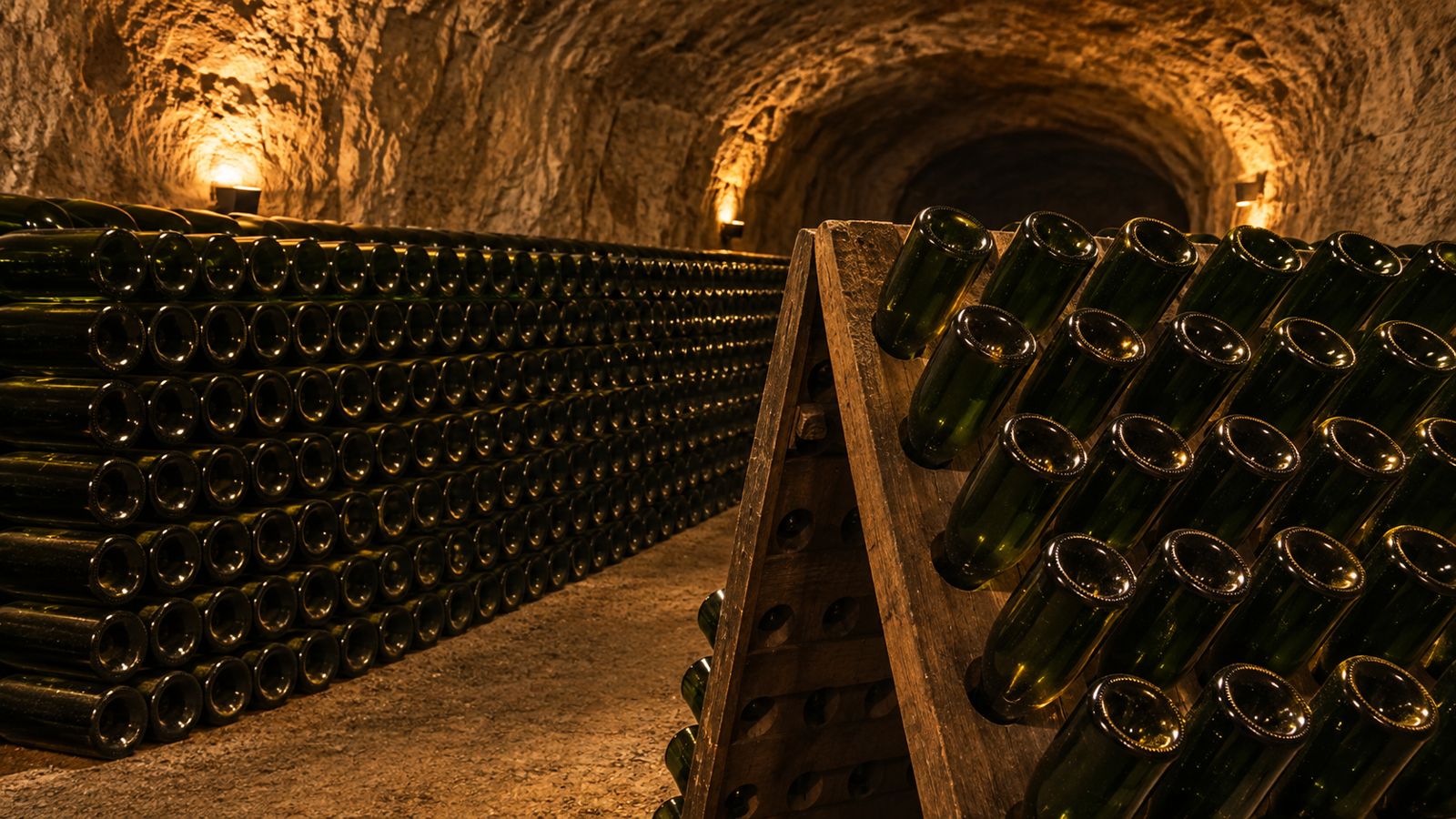
English sparkling and Champagne are usually made the same way: the traditional method. The bubbles come from a second fermentation inside the bottle you eventually open.
The traditional method, step by step
- Harvest. Grapes are usually picked by hand so the bunches arrive whole and undamaged.
- Pressing. Whole bunches are pressed gently and quickly so the juice from black grapes stays pale. In Champagne, 4,000 kg of grapes is allowed to give 2,050 litres of the best juice (the "cuvée") plus 500 litres of "taille", per the Comité Champagne.
- First fermentation. The juice becomes still, dry, sharp base wine, usually in stainless steel and sometimes in oak.
- Blending. The winemaker blends grapes, plots and sometimes older reserve wines into the "cuvée".
- Bottling with yeast and sugar (tirage). A little sugar and yeast go into each bottle, which is sealed with a crown cap.
- Second fermentation. The yeast eats the sugar and makes a little more alcohol, plus carbon dioxide. Trapped in the bottle, that gas becomes the bubbles.
- Ageing on lees. The spent yeast (the lees) slowly breaks down and gives the wine its brioche, biscuit and toast notes and a creamier mousse.
- Riddling. Bottles are gradually tilted neck-down and turned, by hand on a wooden rack or by machine, so the lees slide into the neck.
- Disgorging. The neck is frozen, the cap comes off, and the plug of yeast shoots out.
- Dosage. A small amount of wine and sugar (the "liqueur") tops the bottle up. This decides whether it's Brut, Extra Brut and so on. For a Brut, it's roughly 1cl in a 75cl bottle, per the Comité Champagne.
- Cork, cage and rest. The bottle is corked and rested before release.
Rule of thumb from Champagne: around 1.2 kg of grapes makes one bottle.
Who actually makes the wine?
Growing grapes and making wine are different jobs, and they need different kit. Pressing, fermenting, riddling and disgorging take a winery full of expensive equipment. Many English vineyards grow the grapes and then work with a specialist partner to make the wine.
| Model | How it works | Example |
|---|---|---|
| Own winery on site | Grapes are pressed and made into wine on the estate. | Domaine Evremond since its 2024 harvest. Before that, its wines were made in a barn on the grower's estate where the vines were planted, per Fine + Rare. |
| Contract or partner winery | The vineyard grows and picks. A specialist winery makes the wine to the vineyard's brief, and the wine still carries the vineyard's name. | Fairmile Vineyard, whose wines are made at Hambledon in Hampshire (Tanners). |
| Grape grower | Grapes are sold to someone else's label. | Many smaller vineyards in the WineGB directory list themselves as grape growers. |
Neither model is better. A brilliant partner winemaker can make a small vineyard's grapes shine. When you visit, ask "Where is the wine made, and by whom?" It's one of the best questions you can ask, and on every vineyard page we show the answer where we have it, or "not yet confirmed" where we don't.
Other ways to make bubbles
- Tank method (Charmat). The second fermentation happens in a big pressure tank. It's quicker and cheaper, and it gives fresh, fruity styles like most Prosecco.
- Ancestral method (pét-nat). Bottled before the first fermentation finishes. Often cloudy, rustic and fun.
- Carbonation. CO₂ is added, as in fizzy drinks. Usually the cheapest wines.
The traditional method takes the longest and ties up the most stock, which is a big reason it costs more. See What shapes the price.