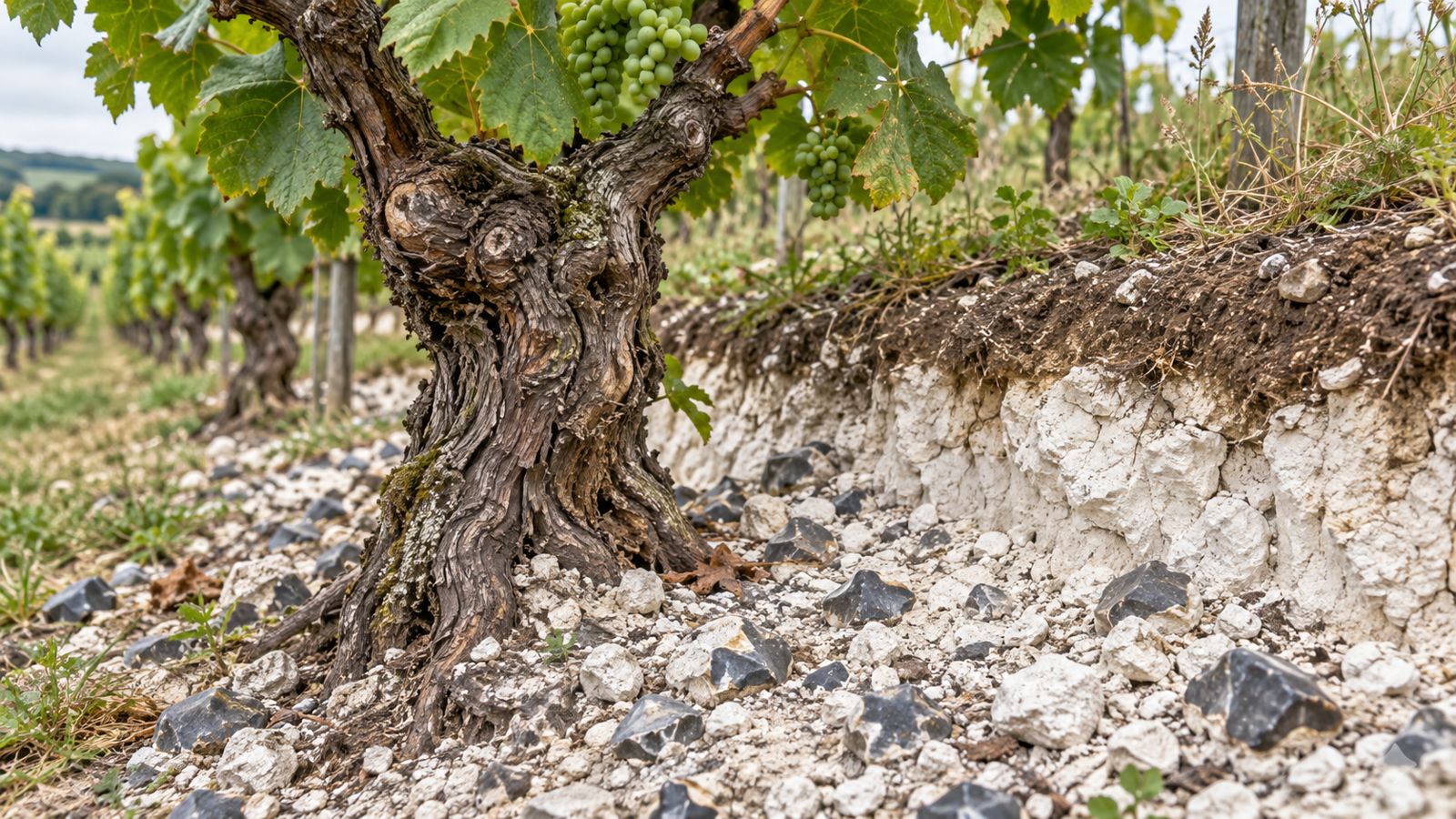
Every bottle starts with a patch of ground and a year of weather. You don't need a geology degree. You just need to know what the soil does for the vine, and what a warm or wet year does to the grapes.
What soil actually does
It's tempting to say chalk soil makes a wine taste "chalky". The science is more interesting than that. The Wine & Spirit Education Trust's report on wine and soil explains that the soil's main job is to give the vine a steady supply of water. It concludes that soil "does not directly provide taste-giving compounds to wine". Flavour comes almost entirely from the grapes' ripeness and from the winemaking.
So soil matters, but indirectly. It controls how much water the vine gets, how warm the roots stay, how vigorous the plant grows, and how quickly the ground drains after rain. All of that shapes how the grapes ripen.
The main soils you'll hear about
| Soil | How it behaves | What that tends to mean | Where you'll find it |
|---|---|---|---|
| Chalk | Drains freely but holds a reserve of water deeper down, like a sponge. Stays cool. | Steady ripening, high natural acidity, lean and precise styles. | Champagne, Kent's North Downs, Hampshire, Sussex, the Chilterns |
| Chalk with flint | Chalk with flint stones mixed in. The flints can hold and reflect a little heat. | Similar to chalk. Producers often talk about tension and freshness. | Domaine Evremond in Kent, Fairmile in Henley |
| Clay | Holds water and nutrients well. Heavier and slower to warm in spring, slower to drain. | Vigorous vines and fuller fruit. Needs careful canopy work in wet years. | The Crouch Valley in Essex, much of the London Basin |
| Greensand and sand | Warms quickly and drains fast. | Early ripening and softer, fruitier styles. | Parts of Kent, Sussex and Surrey |
Our featured vineyards, from the ground up
| Vineyard | Ground | Site | Who makes the wine |
|---|---|---|---|
| The Althorne Estate | Clay, per the estate | South-facing slope towards the River Crouch | Not yet confirmed. We're asking the estate. |
| Domaine Evremond | Deep, free-draining chalk, per Decanter | South and south-west facing slopes near Chilham | On site, in its own winery since the 2024 harvest |
| Fairmile Vineyard | Flinty chalky marl, per Fairmile | Steep slopes in the Stonor Valley, Chiltern Hills | Hambledon in Hampshire, a partner winery, per Vinebound |
| Forty Hall Vineyard | Not yet confirmed | Enfield, north London | Not yet confirmed |
Why the ground changes the price
- Yields. Poorer, well-drained soils usually give fewer grapes per vine. Fewer grapes means fewer bottles, so each one costs more to make.
- Work. Steep slopes and stony ground are harder to farm. More of the work is done by hand.
- Land. Proven chalk slopes in the South East are sought after, and that shows up in land prices.
- Risk. Frost pockets and wet, heavy ground mean more years with a small crop. Growers have to build that into the price.
Weather: one year, many effects
England is a cool climate. That's a big part of why it's good at sparkling wine: grapes keep plenty of natural acidity, which gives the wine its freshness and lets it age. Year to year, the weather moves things around.
| Moment | What can happen | Effect in the glass |
|---|---|---|
| Spring frost | Frost after budburst kills the young shoots | A smaller crop. Quality can still be good, but there's less wine. |
| Flowering (around June) | Cold, wet or windy weather stops flowers setting fruit | Uneven or small bunches and a lower yield |
| Summer | Sunshine and warmth build sugar and ripe flavour | Warm years give riper fruit and rounder wines. Cool years keep sharper acidity. |
| Harvest (September to October) | Rain can bring rot and dilute the juice | Pickers have to sort hard. A rushed pick can mean thinner wine. |
When do they pick?
For sparkling wine, growers pick earlier than they would for still wine. They're watching the balance between sugar (which becomes alcohol) and acidity (which gives freshness). Picking too late loses the zip. Picking too early gives green, sharp flavours. In Champagne, the Comité Champagne sets the earliest picking date for each village and grape, usually about 90 days after full flowering.